premium subsidies
What is a premium tax credit?
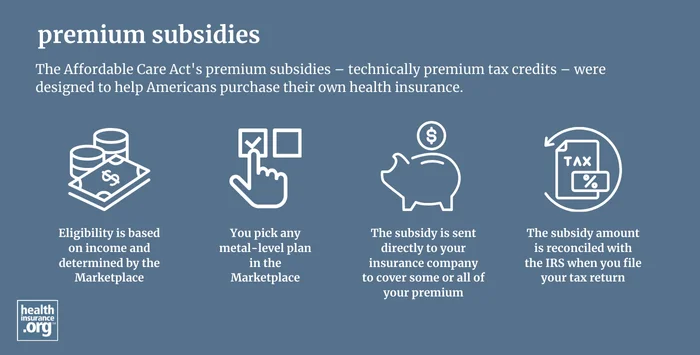
A premium tax credit – often referred to as a premium subsidy – is a tax credit that offsets some or all of the amount that policyholders would otherwise have to pay to purchase individual or family health insurance through the health insurance Marketplace. Premium tax credits are one of many Affordable Care Act provisions designed to make individual market health insurance coverage affordable.
Premium subsidies are only available to use with health insurance purchased through the Marketplace/exchange in your state. (In other words, you forfeit the premium tax credit if you shop off-exchange, even if you’d otherwise be eligible to claim it).
How many people receive premium tax credits?
As of early 2025, CMS reported that more than 21.8 million people – 93% of all Marketplace enrollees at that point – were receiving premium tax credits.1
However, this likely declined in 2026, due to the expiration of subsidy enhancements at the end of 2026, which caused the “subsidy cliff” to return. Premium tax credits are no longer available in 2026 if an enrollee’s household income is above 400% of the federal poverty level.
When do I receive the premium tax credit?
Unlike other tax credits, the premium tax credit can be (and usually is) provided upfront, throughout the year. The Marketplace sends it to your health insurer each month, so that you don’t have to pay as much yourself. The premium tax credit is then reconciled on the policyholder’s tax return the following spring.
Alternatively, policyholders can choose to pay full price for a health plan in their state’s exchange, and then claim the entire premium tax credit on their tax return. However, few people do that, as the cost of coverage without the advance premium tax credit is generally out of reach for those who qualify for the premium tax credit.
What is an advance premium tax credit?
An advance premium tax credit, or APTC, is the name for a premium tax credit when it is paid in advance each month to an enrollee’s insurance carrier. The alternative is to pay full price for health insurance through the exchange/Marketplace and then claim the premium tax credit from the IRS when you file your taxes.
What factors affect an enrollee’s premium tax credit (PTC)?
Premium tax credit eligibility depends on income (an ACA-specific calculation of modified adjusted gross income – MAGI), and how the cost of the benchmark plan (second-lowest-cost Silver plan) in the Marketplace compares with your household’s MAGI.
The rules were different from 2021 through 2025, but have reverted to the original ACA parameters as of 2026: Premium tax credits are only available to people with income between 100% and 400% of the federal poverty level. And the lower bound in most states is actually income above 138% of the federal poverty level, due to Medicaid expansion (if you’re eligible for Medicaid, you won’t be eligible for a premium tax credit, and most states have expanded Medicaid to cover adults with MAGI up to 138% of the poverty level).
The cost difference between the benchmark plan and an enrollee’s selected plan determines their monthly premium. In 2025, the full-price premiums for plans purchased via the Marketplaces nationwide averaged $619 a month, but 93% of enrollees received advance premium tax credits that averaged $550 per month.1 For those enrollees, the average tax credit covered the majority of the average premium, although the specifics vary considerably from one person to another and from one area to another.
Because premium tax credits are usually paid in advance, they are reconciled against your actual income when the year is over. This means enrollees who underestimate their income may have to pay back some or all of their subsidy when filing their taxes. Starting with the 2026 plan year, there is no longer a cap on how much excess APTC must be repaid to the IRS.
Will being offered employer-sponsored coverage make me ineligible for tax subsidies?
You won’t qualify for premium subsidies if you’re eligible (including as a spouse or dependent) for an employer-sponsored plan that meets comprehensiveness and affordability requirements.
In 2026, an employer-sponsored plan is considered affordable if it costs the employee no more than 9.96% of household income. An affordable employer-sponsored plan will disqualify a taxpayer from receiving a tax subsidy if it also provides minimum value (i.e., it covers at least 60% of an average enrollee’s costs and provides “substantial coverage” for inpatient and outpatient services).
Before 2023, this affordability test was based only on the employee’s coverage costs, and the entire family was ineligible for premium tax credits if the employee’s offer of group health insurance was considered affordable (regardless of the cost to add the family members to the group plan). This situation was known as the family glitch.
However, the Biden administration implemented a fix for the family glitch that took effect in 2023. Under the new rules, the cost of the whole family’s coverage under the group plan is taken into consideration, and the family members can potentially be eligible for a premium tax credit in the Marketplace if the group plan isn’t affordable.
Can I receive a tax subsidy if I’m eligible for Medicaid because of the ACA’s Medicaid expansion?
No. Marketplace enrollees aren’t eligible for premium tax credits if they’re eligible for Medicaid or CHIP.
Eligibility for premium tax credits begins at 100% of the federal poverty level in states that did not implement the ACA’s Medicaid expansion. However, the ACA allowed states to expand Medicaid to adults under 65 with incomes up to 138% of the poverty level.
In DC and the 40 states that have adopted the Medicaid expansion, premium subsidies are available beginning above 138% of the poverty level. So an adult earning 125% of the poverty level will qualify for Medicaid in most states, but will instead qualify for Marketplace subsidies if they’re in one of the ten states that haven’t expanded Medicaid.
Eligibility limits for Medicaid/CHIP are much higher for children, and can be above 300% of the poverty line in some states.2 This means that in many households, adults qualify for premium subsidies and children qualify for Medicaid or CHIP.
How is my eligibility impacted if my state didn’t expand Medicaid?
Your household income must be at least 100% of the poverty level to qualify for a premium subsidy. Low-income adults who live in states that didn’t expand Medicaid can fall into a Medicaid coverage gap – where they are ineligible for Medicaid because their state hasn’t expanded eligibility, but do not earn enough to qualify for premium tax credits.
Starting in 2026, there is also a coverage gap for low-income immigrants who have been in the U.S. for less than five years. These individuals are mostly ineligible for Medicaid due to the five-year waiting period for Medicaid, but they are also ineligible for Marketplace subsidies if their income is below the federal poverty level. Prior to 2026, they were eligible for Marketplace subsidies during the five years before they could be eligible for Medicaid, but the "One Big Beautiful Bill" removed that provision starting in 2026.
How did the elimination of federal funding for cost-sharing reductions affect premium tax credits?
In late 2017, the federal government stopped reimbursing insurers for providing cost-sharing reductions (CSRs) – which lower co-pays, deductibles, and other out-of-pocket expenses in Silver plans. (American Indians and Alaskan Natives receive CSRs on any Marketplace plan.)
Silver plan enrollees with incomes up to 250% of the poverty line are legally entitled to CSRs regardless of whether the government reimburses insurers for providing them. As a result, insurers in most states began incorporating the costs of providing CSRs into all Silver plans. This practice is called “Silver loading,” and it increases the premium subsidies available to all enrollees.
Indiana and Mississippi still require insurers to incorporate costs from CSRs using a different method – called “broad loading” – which does not significantly increase premium subsidies for enrollees in those states. But in the rest of the country, premium subsidies are larger than they would have been if the federal government had continued to fund the cost of CSR benefits.
Footnotes
- “Effectuated Enrollment: Early 2025 Snapshot and Full Year 2024 Average” Centers for Medicare and Medicaid Services. Published July 24, 2025 ⤶ ⤶
- “Medicaid, Children’s Health Insurance Program, & Basic Health Program Eligibility Levels” Centers for Medicare and Medicaid Services. December 2023. ⤶